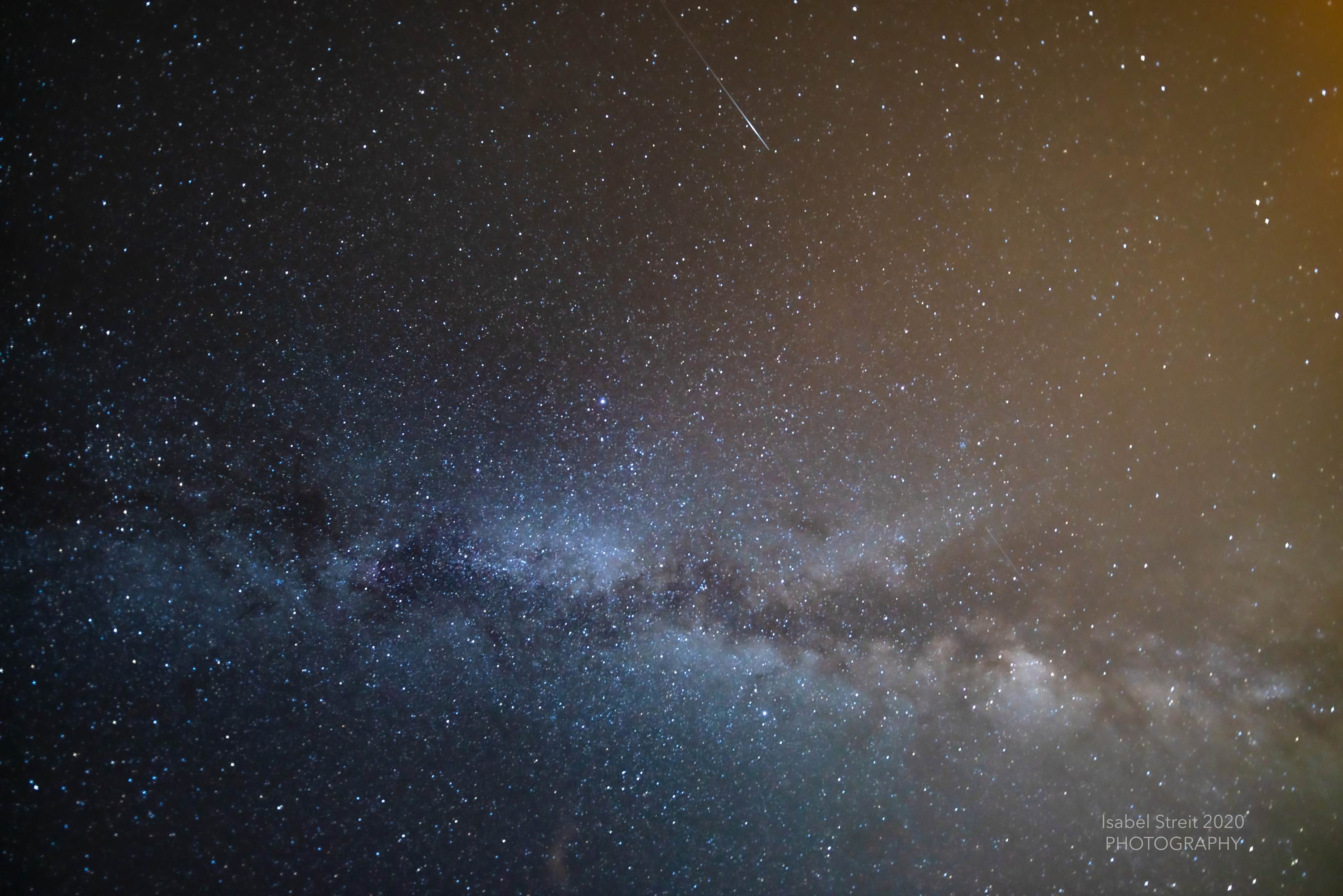
Summary
This article provides an introduction to the Perseids meteor shower, one of the most well-known and widely observed meteor showers, which occurs annually from mid-July to early September. It addresses the formation of meteors, popularly referred to as “shooting stars,” which occur when meteoroids enter the Earth’s atmosphere. Particular emphasis is placed on the provenance of the Perseids, which are attributable to debris from the comet 109P/Swift–Tuttle. Additionally, the article presents a brief overview of the scientific significance of meteor showers. It includes practical guidelines for observing the Perseids, such as the optimal time and location for experiencing the phenomenon. In conclusion, the historical, cultural, and scientific significance of meteor showers is discussed.

Introduction
A meteor, popularly termed a “shooting star,” represents the luminous phenomenon that occurs when a meteoroid (a miniscule particle of extraterrestrial matter or dust) enters the Earth’s atmosphere and burns up due to friction with atmospheric molecules. If the meteoroid survives its entry into the Earth’s atmosphere and subsequently lands on Earth, it is designated a meteorite. Meteors, defined as luminous phenomena, radiate from a specific point in the sky, designated as the radiant. The occurrence of a meteor event is contingent upon the Earth’s passage through a trail of debris, the remnants of a comet or asteroid. Meteor showers occur at regular intervals when the Earth traverses the same region of space where the debris trail is concentrated. The intensity of meteor showers varies considerably, with rates ranging from a few meteors per hour to hundreds during peak times.
What are the Perseids?
The Perseids are among the most well-known and widely observed meteor showers, occurring from mid-July to early September. The Perseids are renowned for their luminosity and recurrence, rendering them one of the most impressive meteor showers of the year. The Perseids reach their zenith around August 11/12, with observations indicating that up to 100 meteors may be visible per hour. The Perseids are particularly popular during the warm summer nights of the Northern Hemisphere. Nevertheless, the Northern Hemisphere also hosts more powerful and luminous meteor showers, such as the Geminids. During their peak, which occurs around December 13/14, this shower produces over 100 particularly bright meteors per hour. However, observation is typically more challenging due to the prevailing weather conditions in December.
Some science facts
Meteor showers are caused by the Earth colliding with a cloud of meteoroids. These debris clouds frequently, though not invariably, originate from comets that have dispersed their material along their orbit. If the material is distributed uniformly along the orbit, annual meteor showers occur when the Earth traverses the stream’s path. The debris particles of meteors exhibit a size range of 1 to 5 millimeters, approximately equivalent to a grain of sand. The meteoroids enter the Earth’s atmosphere at high speeds, reaching approximately 60 km/s for the Perseids, and are subject to atmospheric friction, resulting in their disintegration and subsequent observation as meteors or “shooting stars.” Although it is merely a prespective effect, meteor showers appear to emanate from a vanishing point (also referred to as a radiant), and are named according to the location of this vanishing point. The Perseids appear to come from the constellation Perseus, although again, this is merely a perspective effect. The parent body of the Perseids is identified as comet 109P/Swift–Tuttle, a large, periodic comet. The comet’s orbital period is approximately 133 years, indicating that it takes approximately 133 years to complete one orbit around the Sun. The comet was independently discovered by two astronomers, Lewis Swift and Horace Parnell Tuttle, in 1862, and it is named after both of them in recognition of their discovery. The diameter of the nucleus of Swift-Tuttle is estimated to be approximately 26 kilometers (16 miles). This makes it one of the largest known objects to have made repeated close passes to Earth. The comet is anticipated to make its next appearance in the inner solar system in 2126, following its most recent passage in 1992.
Note on observational bias: Reported meteor rates depend strongly on sky conditions, radiant altitude, light pollution, and observer experience. Zenithal Hourly Rate (ZHR) values represent idealised conditions and should be interpreted accordingly.
Observing the Perseids
The Perseids meteor shower is typically most active between the hours of midnight and dawn. The meteors appear to originate from the constellation Perseus but can be observed throughout the celestial sphere. To optimize the viewing experience, it is recommended to seek a location free of artificial nighttime illumination, where the sky is sufficiently dark. It is advisable for observers to allow sufficient time to adjust their eyes to the low light conditions.
Historical, cultural, and scientific significance
Meteor showers such as the Perseids have been observed and documented by people for centuries. In addition to their cultural importance, they offer valuable scientific insights, including information about the composition of comets and the history of our solar system. This is particularly evident when meteorites are found on Earth. Such observations can yield significant insights into their origin and formation times.
Sources and further reading
Books
- Keller, H.-U. (2019). Compendium of Astronomy: Introduction to the Science of the Universe. Stuttgart: Franckh-Kosmos.
- Trigo-Rodríguez, J. M. (2022). Asteroid Impact Risk. Springer Nature.
Web resources
- International Meteor Organization (IMO): https://www.imo.net/
- NASA Meteor Watch: https://www.meteorshowers.nasa.gov/
- American Meteor Society (AMS): https://www.amsmeteors.org/
Related on this site
- Orionids (October 2023): /articles/orionids/